
 Mexico - Español
  China - 中文
  Australia - English
  Canada - English
  India - English
  United Kingdom - English
  United States - English
  France - Français
  Italy - Italian
  Brazil - Português
  Argentina - Español
  Chile - Español
  Colombia - Español
  Guatemala - Español
  Puerto Rico - Español
  Spain - Español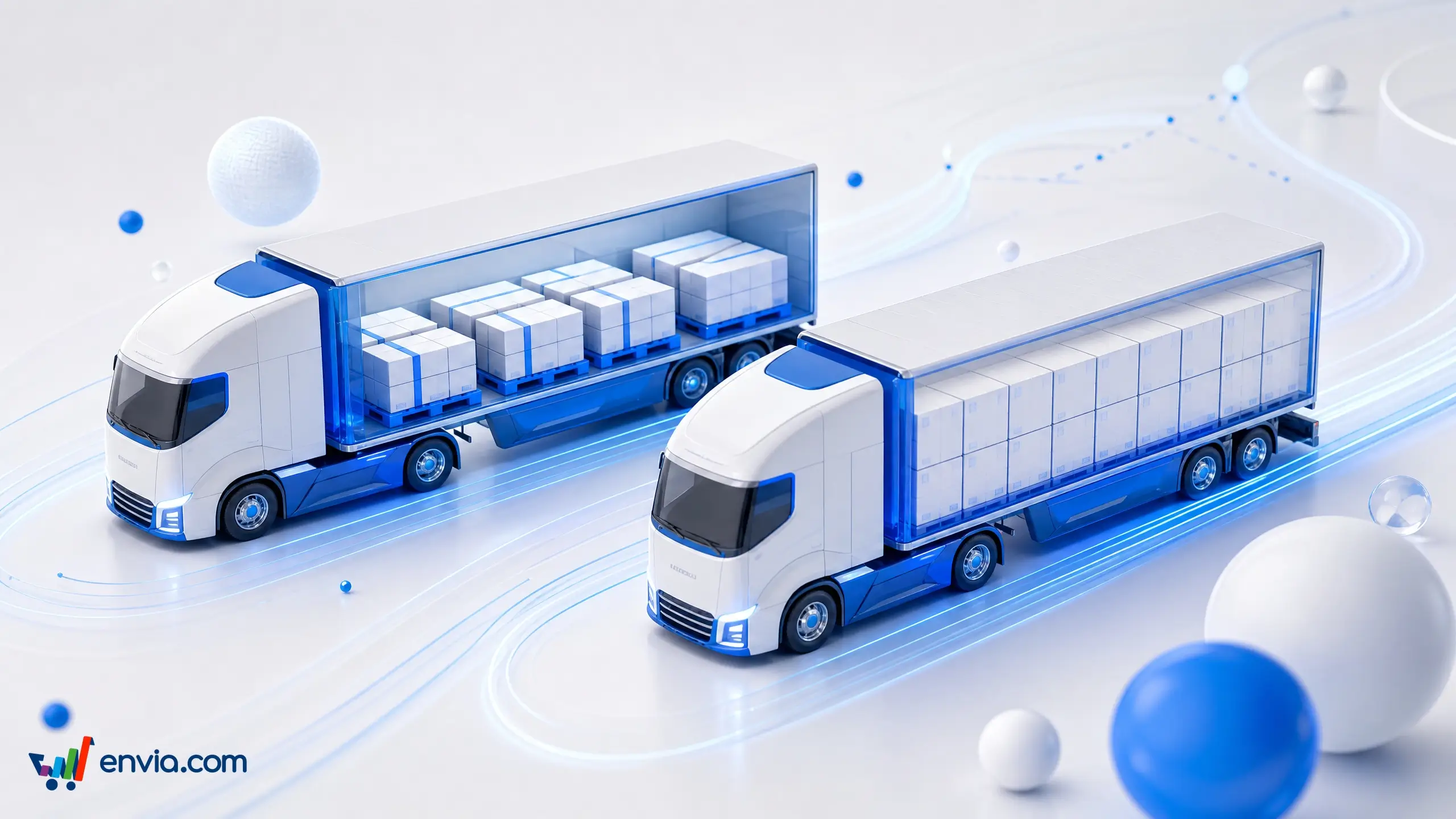
As your business grows, individual packages stop being enough. Eventually you'll need to move pallets, restock warehouses, or ship large volumes to distributors, and that's where two shipping methods every seller should understand come into play: FTL and LTL.
Choosing the right one can mean the difference between overpaying for space you don't use or taking longer than necessary because your freight is sharing a truck with others.
What is Full Truckload (FTL)?
FTL is a type of freight transport where a single company's goods fill the entire truck. It goes straight to its destination with no intermediate stops, offering greater speed, less handling, and full control over timing and costs.
Think of it like chartering a private plane: the truck is exclusively yours.
When to use FTL
- Loads exceeding 10–12 tons
- High-value goods that require minimal handling
- Urgent shipments with critical transit times
- Mass distribution to warehouses or distribution centers
What is Less Than Truckload (LTL)?
LTL freight works like a shared transport system: your goods travel in the same truck as other companies' shipments that have compatible destinations or routes. You only pay for the space your freight takes up, splitting the cost of the trip among all participants.
If FTL is a private plane, LTL is a commercial flight: you share the space and pay only for your seat.
When to use LTL
- Loads between 70 kg and 10 tons
- Restocking inventory at fulfillment centers
- B2B shipments between businesses or distributors
- When your volume doesn't justify a full truck
Difference between LTL and FTL: direct comparison
| Factor | LTL (Less Than Truckload) | FTL (Full Truckload) |
|---|---|---|
| Cost | Only the space used | Entire truck |
| Speed | Slower (multiple stops) | Direct to destination |
| Ideal volume | 70 kg – 10 tons | +10 tons |
| Handling | Higher | Minimal |
| Flexibility | High | Only with large volume |
| Best for | SMBs, restocking, B2B | Large volumes, urgent shipments |
When is it better to use LTL instead of FTL?
According to 99minutos, many companies overpay for a full truckload when they don't need one, or underestimate consolidated service timelines and end up letting their customer down.
Use LTL when your freight doesn't fill a truck, delivery time is flexible, and cost is the main factor.
Use FTL when you have enough volume, punctuality is critical, or your goods are fragile and you need to minimize handling.
How to ship LTL and FTL freight from Envia.com
Envia.com brings both methods into the same platform where you already manage your courier and international shipments. With the LTL consolidated freight service, you can get real-time quotes, manage pallets with no additional contracts, and monitor every shipment from the analytics dashboard.
For loads that justify a full truck, Envia.com's FTL service offers the same visibility and centralized management benefits.
Get a quote for your LTL or FTL shipment on Envia.com here.
Key tips for LTL shipments in Mexico
Pack on a pallet. Your freight will pass through multiple handling points. Use sturdy stretch wrap, clear labels, and adequate protection to avoid damage during consolidation.
Plan for extra time. LTL makes several stops before reaching its destination. Allow for at least 1–2 additional days compared to direct FTL.
Declare exact weight and dimensions. LTL cost depends on the space your freight occupies. An incorrect declaration results in additional charges at destination.
Activate shipping insurance. For loads with multiple handling points, Envia.com's shipping insurance protects your goods throughout transit.
Mexico: freight market context
Mexico closed 2025 as the United States' top trading partner, with $534.874 billion in exports, according to Solistica. Companies that master their freight methods and know when to use LTL versus FTL have a real operational advantage over those who overpay or deliver late.
Ready to optimize your freight transport? Check out the FTL and LTL service and get a quote for your first shipment today.