
 Mexico - Español
  China - 中文
  Australia - English
  Canada - English
  India - English
  United Kingdom - English
  United States - English
  France - Français
  Italy - Italian
  Brazil - Português
  Argentina - Español
  Chile - Español
  Colombia - Español
  Guatemala - Español
  Puerto Rico - Español
  Spain - Español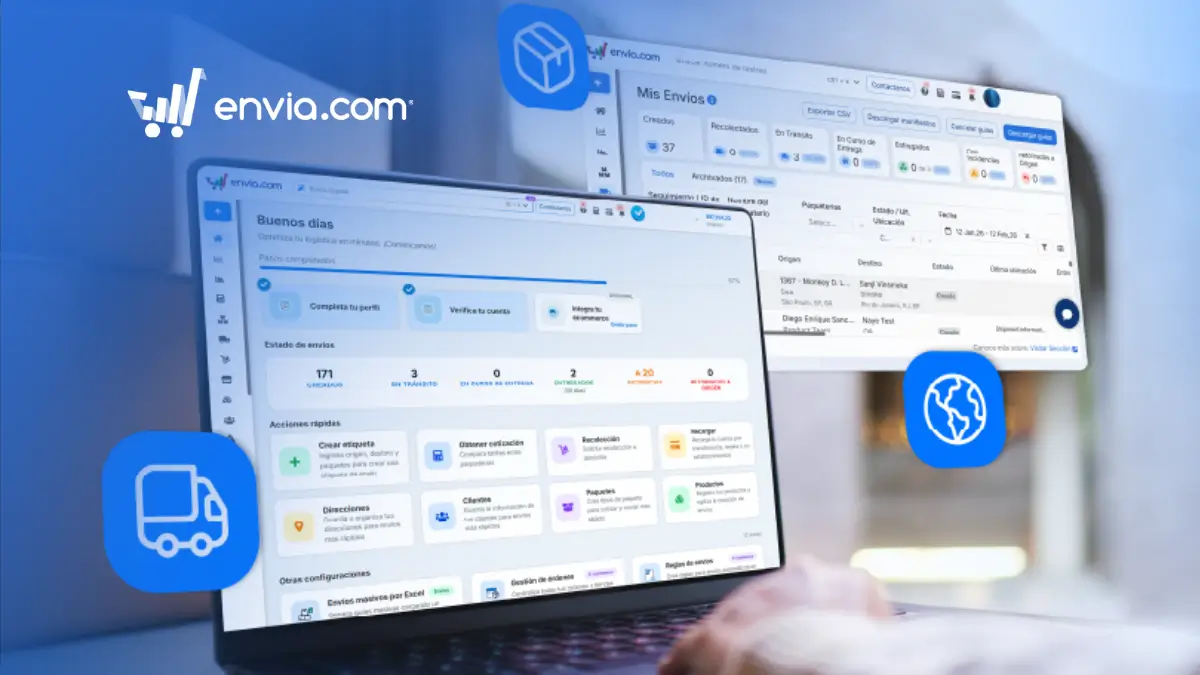
If you're in charge of shipping for your business, you've probably already come across the term shipping platform, but it's not always clear exactly what it is or why more and more businesses are using one. In short, a shipping platform is a technology tool that connects your business with multiple carriers, so you can get quotes, generate labels, and track your shipments from a single place, instead of managing each carrier separately.
Before shipping platforms existed, businesses looking for the best option for each order had to get quotes directly from each carrier and compare prices, delivery times, and coverage separately. If they also worked with several carriers, tracking shipments became even more complicated, since they had to check each package's status on each company's own portal. This process took time and made it harder to manage an operation with multiple shipments, especially for businesses that sell online or distribute products to different cities or countries.
A shipping platform solves exactly that problem: it centralizes, optimizes, and automates a business's shipments, simplifying tasks that used to take hours.
How does a shipping platform work?
Using a shipping platform is quite simple: you sign up (for free on some platforms, or through a subscription on others), add funds to your account, and from there you can get quotes for your shipments from multiple carriers at the same time, generate the labels you need, and track all your shipments in real time. Some platforms even let you send automatic notifications to your customers to keep them informed about the status of their orders. You only need to enter your shipment's information once to get quotes from different carriers. Many platforms also let you save addresses, frequent packages, and other settings to speed up creating and quoting future shipments.
If you have an online store on platforms like Shopify, WooCommerce, Tiendanube, or others, many shipping platforms let you integrate it easily so your order labels are generated automatically, saving time and reducing data-entry errors.
Why do I need a shipping platform for my business?
You might be wondering whether you really need a shipping platform. If the tool has a monthly cost, the decision may depend on the volume of shipments you handle. However, if it's a free platform, it's worth using from your very first shipment: you have nothing to lose, and it will help you compare options, save time, and manage your shipments much more easily.
Here are some signs that a shipping platform could help you:
- You waste time manually comparing rates every time you need to ship a package.
- You work with more than one carrier and find it hard to keep track of labels and tracking across different systems.
- Your customers often ask where their order is, because they don't have an easy way to track it.
- You frequently make mistakes with addresses or shipping data when entering them manually.
If any of these situations sound familiar, a shipping platform can help you save time, reduce errors, and offer a better experience to your customers, with competitive shipping options, more efficient deliveries, and full order visibility at all times.
Most common features of a shipping platform
Although each platform is different, most share certain basic features:
- Instant quotes. See rates from multiple carriers in seconds from a single place, without having to get quotes on each carrier's own website separately.
- Multiple carriers in one place. Being able to choose between different carriers depending on the destination, instead of relying on just one.
- Low rates. Access to preferred rates that are normally hard for a small or medium business to get on its own.
- Real-time tracking. Knowing exactly where each package is, both for the business and for the end customer.
- All your shipments in one place. Manage and track all your shipments from a single dashboard, with access to your label history and the ability to send automatic notifications to your customers about the status of their orders.
What to check before choosing a shipping platform
Not all shipping platforms work the same way, so before settling on one, it's worth reviewing a few points:
- Coverage and number of available carriers. Not all platforms offer the same network of carriers. Some only integrate a handful of options, while others have dozens or even more than 100 carriers. The more alternatives you have, the easier it will be to find the best combination of price, coverage, and delivery time for each shipment.
- Ease of use. A complicated platform ends up creating more work than it saves; if your team needs extensive training just to generate a label, it's probably not the right tool.
- Integrations with your store or sales channels. If you sell from an online store or a marketplace, look for a platform that offers a wide variety of integrations. That way, if you start selling across multiple channels in the future, you'll be able to connect all your orders and manage them from a single place.
- Automation of repetitive tasks. Rules that automatically assign the cheapest or fastest carrier based on destination, without having to choose manually for each shipment.
- Customer support. Choose a platform that offers local support in your language and, if possible, in your country. It's also a good idea to be able to easily reach an advisor or account manager whenever you need to resolve questions or issues, especially for important shipments.
Most important: check whether the platform charges you a fixed monthly fee, regardless of how much you ship. Some tools on the market do charge a monthly fee on top of the cost of each shipment, which may not make sense if your shipping volume varies from month to month. Ideally, look for a platform where you only pay for what you actually ship, with no fixed fees involved.
A shipping platform can simplify a business's logistics, especially as order volume grows. To choose the right option, it's important to find a balance between costs and features: a cost-effective platform with a flexible pricing model, that also offers tools to automate processes, reduce manual tasks, and manage your shipments more efficiently.
If after reading this you feel a shipping platform would be good for your business, you can sign up for free on Envia.com today, with no monthly fees or commitments: you only pay for what you ship. You can sign up for free to explore the platform, or request personalized guidance if you need help getting started.