
 Mexico - Español
 China - 中文
 Australia - English
 Canada - English
 India - English
 United Kingdom - English
 United States - English
 France - Français
 Italy - Italian
 Brazil - Português
 Argentina - Español
 Chile - Español
 Colombia - Español
 Guatemala - Español
 Puerto Rico - Español
 Spain - Español
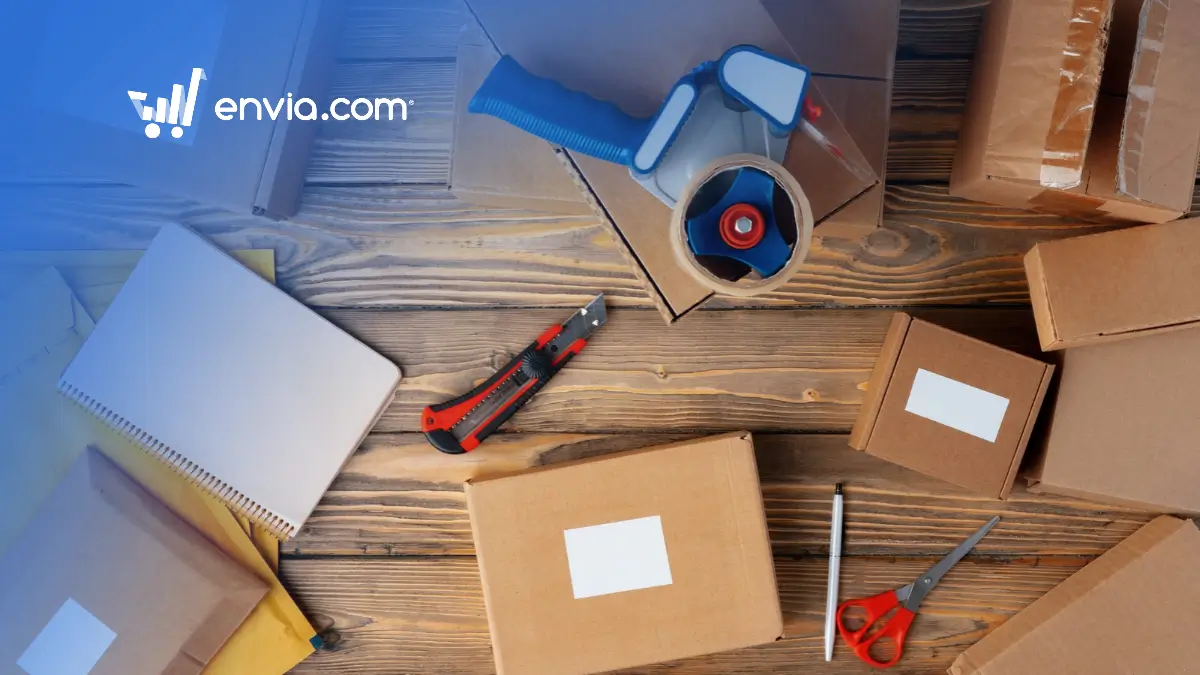
The packaging of your products does far more than contain them: it protects your merchandise in transit, reduces returns due to damage, and conveys the quality of your brand the moment the customer opens the package. Choosing the wrong material can cost you a damaged product, a claim with the carrier, or a customer who doesn't come back.
The good news is that you don't need to be a logistics expert to pack well. You just need to understand what function each material serves and how to apply it based on the type of product you ship.
What function does packaging serve in a shipment?
According to Coordinadora, packaging serves several functions at once within the distribution chain:
- Physical protection: shields the product from impacts, drops, and compression during handling and transport.
- Preservation: protects the contents from external factors such as moisture, temperature, and contamination.
- Logistics optimization: makes efficient use of space in vehicles and warehouses, which directly affects the cost of shipping.
- Legal information: complies with regulations by including handling instructions and sender and recipient information.
- Brand experience: well-designed packaging builds recall and can become part of the buying experience that sets your business apart.
Types of packaging: primary, secondary, and tertiary
Before choosing materials, it helps to understand which level of packaging you're working with:
- Primary packaging: is in direct contact with the product. It's the first layer of protection (bottles, individual boxes, sealed bags).
- Secondary packaging: groups several units of primary packaging. In ecommerce, it's often what the customer receives: the outer box with the contents inside.
- Tertiary packaging: is designed for transporting large volumes: pallets, master cartons, stretch film. It applies when you handle wholesale distribution or large lots.
For most ecommerce shipments, the focus is on secondary packaging: the box or mailer that leaves your hands and reaches the customer.
What materials are used to pack a shipment?
Corrugated cardboard boxes
They're the most widely used material for ecommerce shipping. Their strength depends on the number of layers (flutes) in the cardboard:
- Single wall: for lightweight products with a low risk of damage.
- Double wall: for medium-weight or moderately fragile products.
- Triple wall: for heavy, fragile, or high-value products.
According to DHL, heavier or more delicate products usually require double- or triple-wall boxes, and you should avoid reusing worn boxes, since they weaken over time and offer less protection. In addition, most boxes include a manufacturer's stamp indicating their strength.
Mailers and bags
For flexible, lightweight, non-fragile products (clothing, documents, accessories), polyethylene mailers or padded bags are a cheaper and lighter option than boxes. They take up less volume and reduce the shipment's dimensional weight.
Tubes and cylindrical packaging
For posters, blueprints, rolled fabrics, or any item that can't be folded. They're specific to this type of product and prevent damage from bending.
Insulation: when and how to use it
Insulation is necessary when your product is sensitive to temperature changes or prolonged vibration:
- Perishable or temperature-sensitive products (food, medicine, cosmetics): use packaging with insulated walls, gel ice packs, or dry ice depending on transit time.
- Vibration-sensitive electronics: polyethylene foam or boxes with internal foam absorb vibrations on long routes.
- Products that must not get wet: wrap the contents in airtight bags or polyethylene plastic before placing them in the box.
Tip: If you ship products that require controlled temperature, always check whether the carrier you choose accepts and handles that type of shipment before generating your label.
Filler and interior protection
Empty space inside a box is one of the biggest risks in a shipment: objects that move freely knock against each other and against the walls of the box. These are the most commonly used filler materials:
- Bubble wrap: excellent impact absorption. Ideal for wrapping individual fragile items before placing them in the box. Use at least two layers for very delicate products.
- Crumpled kraft paper: inexpensive, recyclable, and biodegradable. It works both to fill gaps and to create cushioning layers around the product.
- Foam or polyethylene foam: for high-value or very fragile items. It can be cut to the product's size to create a perfect fit.
- Tissue paper: it doesn't protect against impacts, but it adds presentation and keeps delicate surfaces from getting scratched.
- Air pillows: lightweight and bulky, ideal for filling large gaps without adding weight.
Tip: A simple test to know whether the filler is enough: close the package and shake it gently. If you hear or feel movement inside, you need more filler.
Type of labeling
Your shipping label has to serve two functions: identify the package for the carrier and communicate handling instructions. According to Coordinadora, these are the elements it should include:
- Complete recipient information: name, detailed address, zip code, and contact number.
- Sender information: so the package can be returned if it can't be delivered.
- Handling instructions: "Fragile," "This Side Up," "Do Not Compress." Use visible adhesive warning labels when they apply.
In addition, the tracking number and barcode must be printed at good resolution and applied to a flat, visible surface, free of seams or corners.
Practical tips before every shipment
- Choose the right box size. A box that's too large increases dimensional weight and shipping cost; one that's too small doesn't allow for adequate filler. The product should have enough room on every side for cushioning material.
- Seal properly. Use professional packing tape at least 2 inches (5 cm) wide. Apply the "H" method (sealing the center seam and both edges of the box) and reinforce the corners on heavy packages. Never use masking tape or paper tape for shipping.
- Document with photos. Take photos of the product before packing and of the package once sealed. This documentation is essential if you need to file a damage claim with the carrier.
- Test your packaging before using it at scale. If you're going to roll out a new type of box or material, test it first under conditions that simulate real transit: drops, compression, and moisture.
- Standardize your sizes. If you handle several products, define a catalog of standard boxes. This simplifies the packing process, makes it easier to quote shipments, and helps you anticipate costs more precisely.
Where can I get the right materials?
Having the right packing supplies on hand is part of an efficient operation. Para Paquetes is a store specializing in packing supplies where you can find corrugated cardboard boxes in different sizes, bubble wrap, kraft paper, packing tape, bags, mailers, and warning labels, all in one place.
If you already use a shipping platform to manage your labels, check whether it also offers access to packing supplies: having everything integrated cuts down on steps and lets you operate more consistently on every order.